ACVAA Anesthesia Monitoring Guidelines: Every 5 Minutes
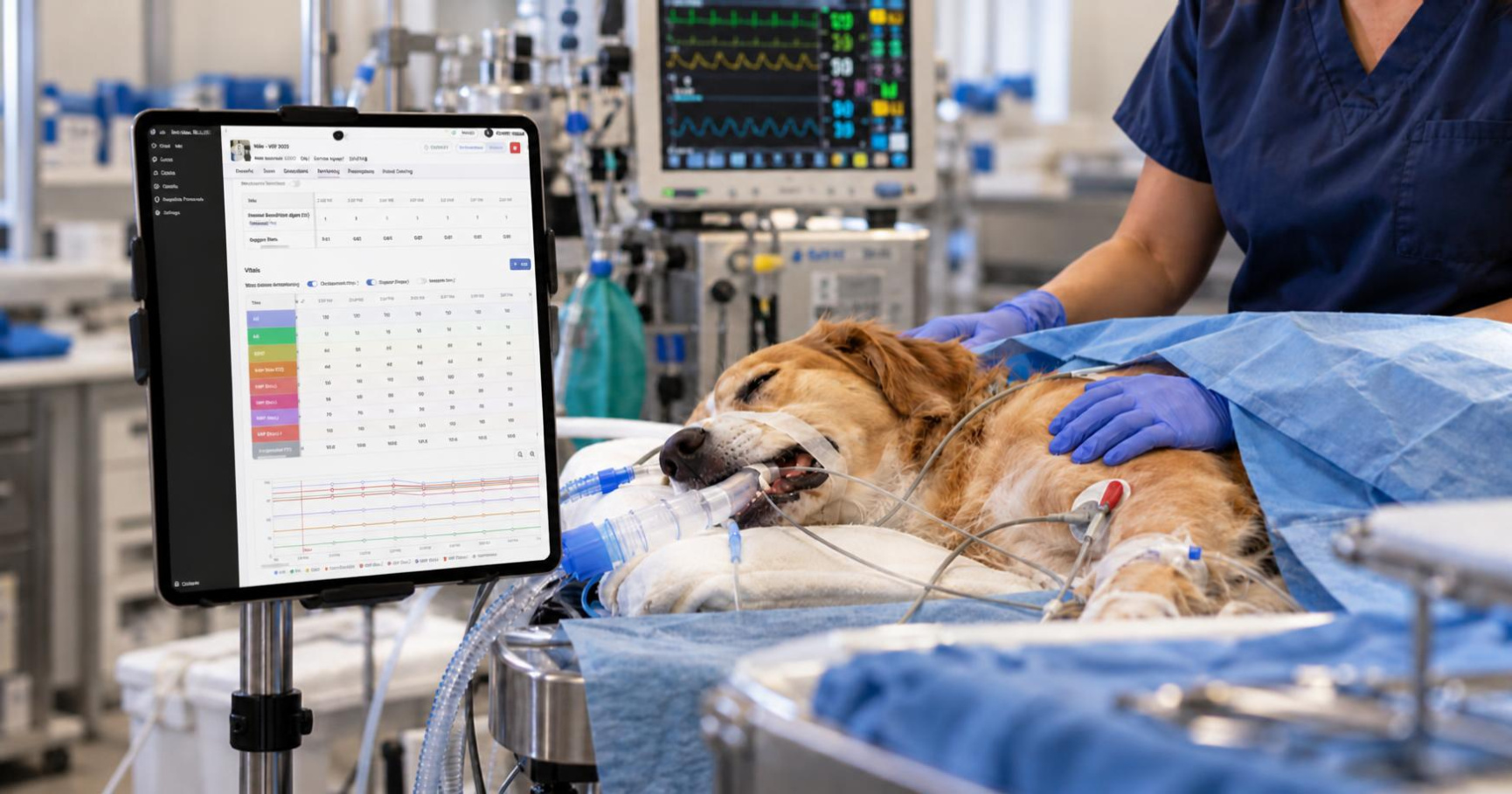
The American College of Veterinary Anesthesia and Analgesia (ACVAA) publishes monitoring guidelines for small animal anesthesia. In 2025, they released the first revision since 2009, with new guidance on sedation, recovery and record keeping. Capnography is now part of the minimum monitoring recommendations, not an extra. As summarized by dvm360, the current version asks practices to record key vital signs on a monitoring form every 5 minutes.
That sounds simple. As a GP, I know that in a general practice running a packed surgical schedule, with dentals, spays and lump removals back to back, it is not.
What the guidelines ask for
The core recommendations include:
- A dedicated person monitoring the patient and the anesthetic.
- Vitals documented every 5 minutes on a monitoring record.
- Temperature checked by rectal or esophageal probe about every 15 minutes.
- Blood pressure, ECG and capnography, not just pulse oximetry.
- Duration of anesthesia tracked from induction to recovery.
I recommend reading the full guidelines, which are free to read, for the complete list and the reasoning behind each item.
Where practices fall short
Most teams I talk to believe in the standard. The gaps come from the workflow:
- One tech, two jobs. The person monitoring is also scaling teeth or opening packs.
- Paper sheets fill in late. Values get written from memory or copied off the monitor after the fact.
- Temperature gets skipped. It is the easiest check to forget in a long case.
- Recovery is a blind spot. Monitoring stops when the tube comes out, right when most complications start.
Practical ways to close the gap
Here is what I would do in any practice:
- Assign the anesthetist before induction. Write the name on the whiteboard. If no one is free, the case waits.
- Use a timer. A 5-minute interval timer on the monitor or a phone keeps charting honest.
- Make capnography standard. EtCO2 is often the first warning of trouble with ventilation or the airway.
- Set a recovery protocol. Keep recording until the patient is sternal and temperature is trending up.
- Audit a few records a month. Look for gaps, late entries and missing temperatures. Share the results as a team.
Why the record matters as much as the monitoring
Guidelines exist to catch problems early. A record that is complete and on time lets the team see trends, not just single numbers. It also protects the practice if an outcome is ever questioned.
The bottom line
I believe the ACVAA guidelines are achievable in general practice. Most of the work is making the record easy enough to keep up with in real time.
At Scout, we pull anesthesia charting off paper and onto a tablet, with prompts at each interval so nothing gets skipped. See how it works