Five Doctors, Five Protocols: Standardizing Anesthesia
One of the hardest parts of being a tech in a multi-doctor practice is that every doctor does anesthesia differently.
One wants a specific premed for every dental. Another changes the induction drug depending on the day. The relief vet on Thursday has a third approach. The tech is expected to remember all of it, draw it up correctly, and catch the mistakes.
That is not a personality problem. It is a system problem, and it shows up in vet tech communities again and again.
Why protocol chaos is a safety issue
Variation is not always bad. Good anesthesia is individualized to the patient. The problem is variation that comes from the doctor, not the patient.
When protocols change by who is on the schedule:
- Drug errors get easier. Different drugs, concentrations and doses every day mean more chances for a calculation mistake.
- Techs cannot build expertise. It is hard to get good at recognizing what is normal when what is normal keeps changing.
- Prep slows down. Every case starts with a question instead of a plan.
- Frustration builds. Techs feel like they are managing doctors instead of patients.
Standard does not mean rigid
The goal is not one protocol for every patient. The 2020 AAHA Anesthesia and Monitoring Guidelines say each patient should be treated as an individual, but that having a set of anesthesia plans used repeatedly is appropriate. It gives the team comfort with its protocols while still adjusting for each patient. Standardizing means agreeing on the starting point, so the changes are driven by the patient.
A practical structure:
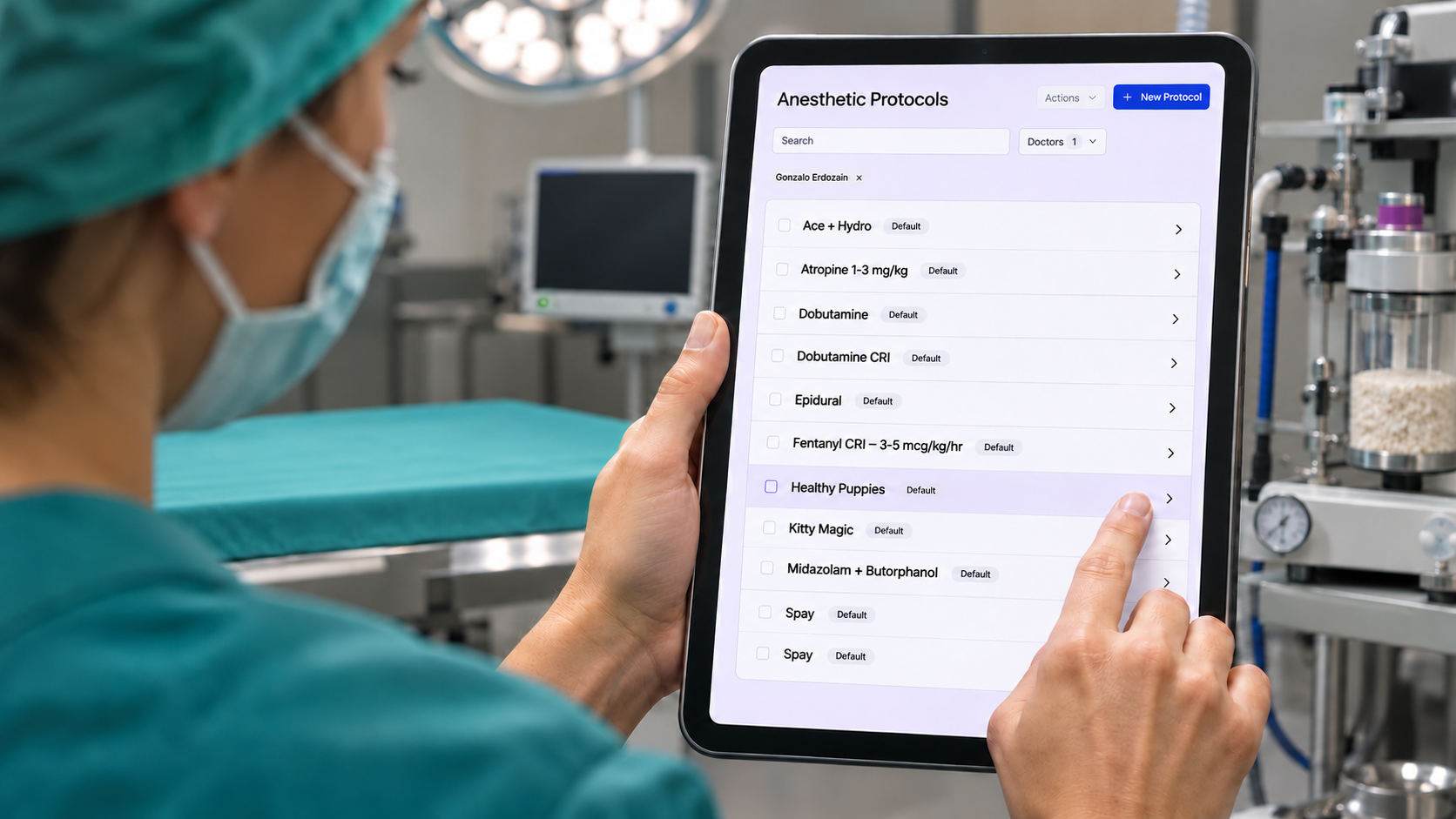
- A small set of default protocols by patient type, for example healthy young patients, seniors, brachycephalic breeds and cardiac patients.
- Clear rules for when to deviate, decided by ASA status and procedure, not preference.
- Documented reasons when a doctor changes the default, so the team learns from it.
How to get there
- Start with what you already do. Pull a few weeks of anesthesia records and list the protocols actually being used. Most practices find more overlap than they expected. If your records are digital, this takes minutes: a dashboard can show which drugs and protocols your team uses most.
- Get the doctors in one room. Agree on three to five defaults. Bring the evidence and keep it short.
- Give techs a real voice. They see every protocol in action. Their input catches problems doctors miss.
- Write it down where it is used. A protocol in a binder in the office does not help at the anesthesia machine.
- Include relief vets. Send the defaults before their first shift and ask them to use them unless the patient needs something different.
- Review every quarter. Look at complications and near misses, and update the defaults as a team. Tracking complications by protocol shows whether a change actually helped. When a single case goes badly, a fair review matters even more, which I wrote about in After an Anesthetic Death: Grief, Review and the Record.
What techs can do now
If your practice has not standardized yet, you can still push it forward:
- Keep notes on which protocols each doctor uses, and bring the list to a team meeting.
- Propose a pilot with one patient type, like healthy dentals. Dentals are also where one tech often ends up doing two jobs, which I covered in Staffing Anesthesia Safely During Veterinary Dentals.
- Frame it around patient safety and efficiency, not complaints. That conversation is easier to say yes to.
How it works for us
I practice in a ten-doctor hospital. With that many doctors, shared protocols are not optional for us. They let all of us work efficiently, safely and fast, and they make it easy to see what is standard and what is not.
The bottom line
Individualize for the patient, not the doctor. A few shared defaults make anesthesia safer, prep faster and the tech's job a lot more sustainable.
With Scout, practices set hospital-wide anesthesia protocols alongside each doctor's own, with automatic drug calculations, and a dashboard shows which drugs your team uses most and where complications happen. Every doctor and relief vet starts from the same safe defaults. Book a demo
Next from Scout